

How AI Is Rapidly Changing the Spam Filtering Landscape
For years, email spam filters worked like strict security guards with a checklist.
They looked for suspicious keywords, strange formatting, blacklisted IP addresses, or domains that had a bad reputation. If your message triggered too many rules, it landed in the spam folder.
But that world is changing fast.
Today, the largest email providers—like Google (Gmail), Microsoft (Outlook/Hotmail), and Yahoo—are increasingly using artificial intelligence and machine learning to decide which emails reach the inbox.
And AI is transforming the spam filtering landscape in ways that many email senders still underestimate.
Let’s look at what’s happening.
From Rules to Learning Systems
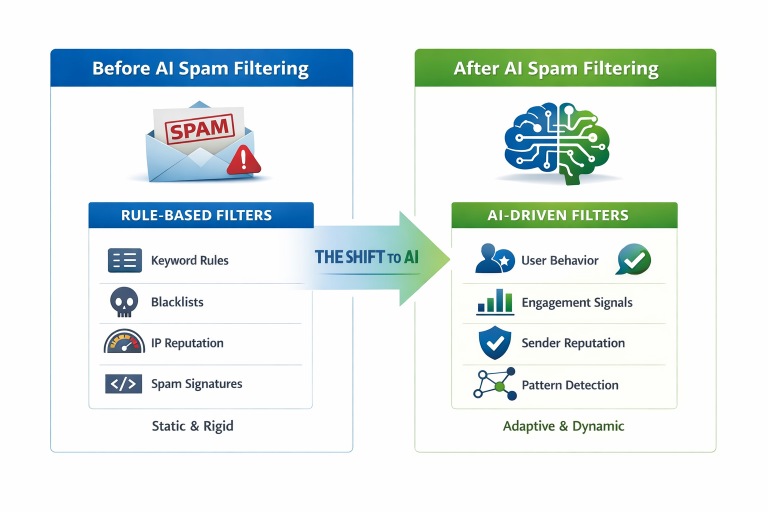
Traditional spam filters were rule-based systems.
They checked things like:
- Certain “spam words”
- Suspicious links
- HTML formatting
- Sender IP reputation
- Blacklists
These systems worked reasonably well, but they had limits. Spammers constantly learned how to bypass the rules.
AI changed the game.
Modern spam filters are no longer just rule engines. They are learning systems that constantly analyze massive amounts of email data and adapt over time.
Instead of asking:
“Does this email contain suspicious words?”
AI systems ask:
“How do users interact with emails from this sender?”
That is a huge difference.
Behavior Is the New Signal
Today, spam filters care much more about recipient behavior than about specific words in the email.
AI models look at signals such as:
- Do people open the email?
- Do they delete it without reading?
- Do they mark it as spam?
- Do they reply?
- Do they move it to another folder?
- How long do they spend reading it?
If many recipients ignore or delete a message quickly, AI systems may learn that the sender’s emails are not wanted.
On the other hand, if recipients regularly open and interact with the messages, the sender builds a stronger reputation.
In other words, spam filtering has become behavior-driven.
Reputation Is Now Dynamic
In the past, sender reputation changed slowly.
Today, it can shift much faster.
AI models constantly update based on new data. That means a sender’s reputation can improve or decline within days—or even hours—depending on user signals.
For example:
A company launches a campaign to a poorly maintained email list. Many recipients ignore or delete the message.
The AI system notices the pattern quickly and may start placing future emails from that sender into spam folders.
But the opposite is also true.
If engagement improves, reputation can recover faster than it used to.
AI Detects Patterns Humans Cannot See
One of the biggest advantages of AI is its ability to analyze enormous datasets.
Spam filters today can evaluate signals such as:
- Sending volume patterns
- Domain age
- IP history
- Link networks
- Campaign timing
- Similar message structures across senders
If hundreds of suspicious campaigns suddenly appear with similar characteristics, AI models can detect the pattern almost instantly.
This is something traditional rule-based systems struggled with.
Content Matters Less Than Many Think
Many marketers still focus heavily on avoiding certain words or tweaking HTML formatting to avoid spam filters.
While content still matters, it is no longer the main factor.
Two identical emails can have very different outcomes depending on the sender’s reputation.
For example:
- A trusted sender with strong engagement may reach the inbox.
- A new or unknown sender with weak engagement may land in spam.
Modern spam filtering systems trust historical behavior and reputation far more than small content differences.
The End of “Spray and Pray” Email
One major consequence of AI-based filtering is that large, untargeted email blasts are becoming much less effective.
Sending to cold lists or poorly maintained databases often produces weak engagement signals. When AI systems detect this pattern, inbox placement declines quickly.
This is one reason why many senders now focus more on:
- List quality
- Subscriber engagement
- Gradual sending ramp-up
- Consistent sending patterns
In the AI era, email success is less about volume and more about relevance and trust.
AI Also Protects Legitimate Senders
While spam filters can sometimes be frustrating, AI also benefits legitimate senders.
Modern filtering systems help detect:
- Compromised email accounts
- Phishing campaigns
- Bot-driven spam networks
- Malware distribution
By removing large amounts of malicious traffic, inbox providers help protect users—and improve the overall email ecosystem.
For responsible senders, strong filtering can actually make it easier to reach engaged recipients.
An AI vs. AI World
Another interesting development is that both sides of the email ecosystem are now using artificial intelligence.
Some attackers use AI tools to generate spam messages, phishing emails, or large networks of fake domains.
At the same time, inbox providers are using increasingly sophisticated AI models to detect those patterns.
This creates a kind of technological arms race between attackers and defenders.
What This Means for Email Senders
For companies sending legitimate email, the lesson is clear: deliverability now depends more on trust and engagement than on technical tricks.
Some important best practices include:
- Sending only to recipients who expect your emails
- Maintaining clean, updated mailing lists
- Building reputation gradually for new domains or IP addresses
- Using proper authentication (SPF, DKIM, and DMARC)
- Avoiding sudden spikes in sending volume
- Monitoring engagement and complaints
In the AI era, consistent sending behavior and strong recipient relationships are more important than ever.
Looking Ahead
AI will likely continue to reshape spam filtering over the coming years.
Future systems may evaluate each email in even more detail, combining sender reputation, recipient behavior, network patterns, and real-time signals to make inbox decisions.
For email senders, this means one thing above all:
The path to the inbox increasingly depends on trust, consistency, and genuine engagement.
And those are signals that no shortcut can replace.